World Models Across the Embodied Loop:A Survey from Agent-Centric Prediction to Environment-Enhanced Adaptation

Zirui Li1, Boyu Ma1, Haochen Liu2, Zhehao Jin3, Zhidong Wang1, Lei Yang1, Xiaocong Zhao4, Zitong Shan1, Jingsong Liang1, Guang Chen2, Shengbo Eben Li5, Jian Sun4, Chenguang Yang6, Jianfei Yang1, Ziwei Liu1, Chen Lv1,* (corresponding author)

1Nanyang Technological University 2Xiaomi EV 3University of Liverpool 4Tongji University 5Tsinghua University 6The Hong Kong Polytechnic University

Corresponding author

BibTeX
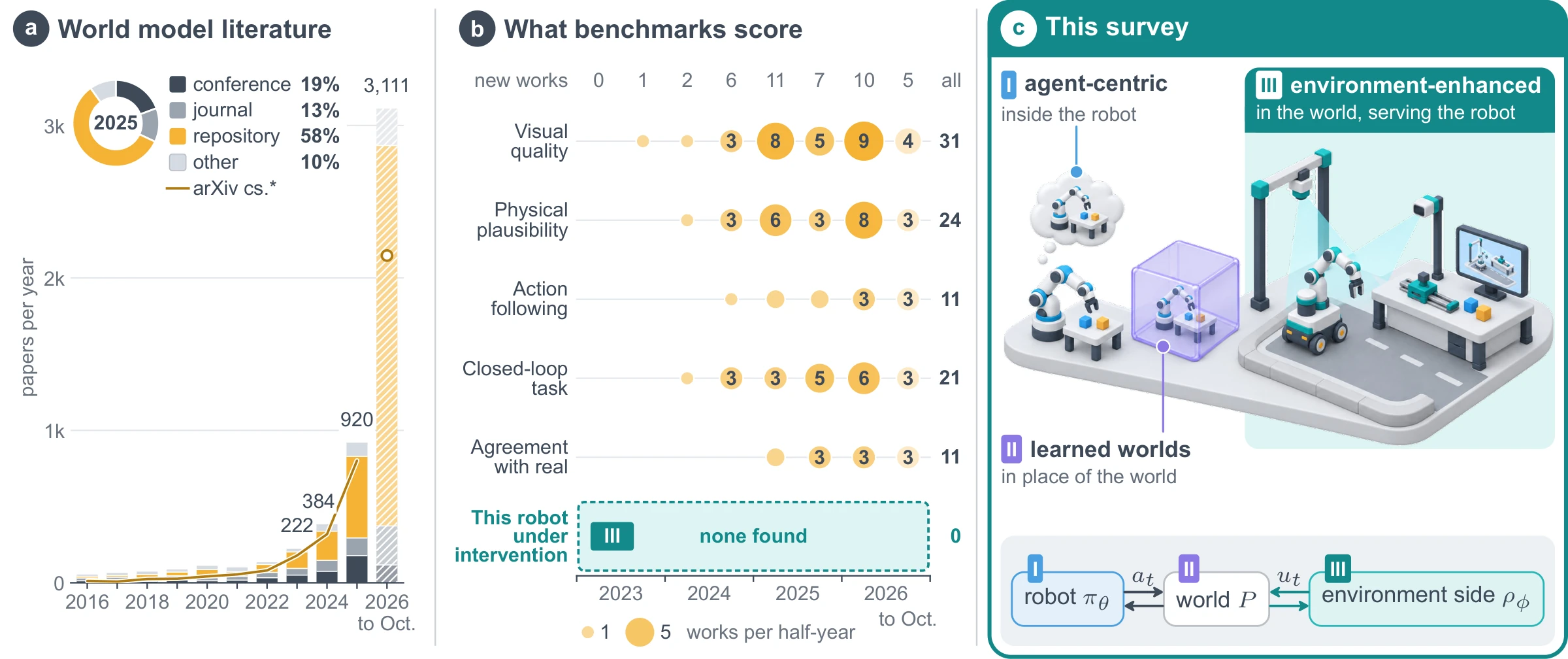
Survey Fig. 1 in three panels. (a) Stacked bars of world model works per year from 2016 to 2026 by document type, rising steeply after 2023, with a line for arXiv cs.* submissions. (b) Bubble matrix of what world model benchmarks and validated learned policy evaluators score by half-year: visual quality, physical plausibility, action following, closed-loop task and agreement with real outcomes are populated; the bottom row, this robot under intervention, reads none found. (c) A scene with a robot that imagines inside its own model (I), a glass cube standing in for the world (II) and a workcell that watches the robot and serves it (III).

The world model literature has grown rapidly since 2023 (a), yet its benchmarks do not yet test the third placement: none of the 42 world model benchmarks and validated learned policy evaluators reviewed scores prediction of a particular robot under interventions chosen for it (b). The survey places a world model inside the robot (I), in place of the world (II) or with an environment side that serves the robot (III), its focus (c).

Fig. 1 of the survey. (a) OpenAlex works in computer science, robotics and driving whose title or abstract contains “world model(s)”, by the document type of their primary location; the line counts matching arXiv cs.* submissions; 2026 runs to October 16, and its type split reflects indexing lag. (b) Bubble area gives the works per half-year of first release (arXiv v1 or publication) that score each criterion; one work can score several; task-stream benchmarks such as LIBERO are not counted. Full-size image

Abstract

Robots now plan and act with world models, learned predictors of how the world evolves under actions and interventions, and are trained and evaluated inside them. World model related surveys take the robot’s viewpoint, leave each use’s requirements implicit and overlook environments that predict and adapt to the robot; such assistance can be mistaken for robot competence. This survey makes four contributions. First, it places world models in one loop with two decision-makers, where an assignment rule separates agent-centric world models inside the robot, learned worlds in place of the world, and environment-enhanced world models that the environment queries for this robot. Second, it reviews the first two paradigms by query and use: in reported results, usefulness tracks action-faithful, closed-loop prediction more than visual realism, and learned evaluators are validated mainly by rank agreement on a few fixed policies. Third, its coded evidence map of environment-enhanced world models shows that environments predict the robot mainly with outcome critics and preview changes with physics engines and digital twins, rarely with learned world models. Fourth, it proposes a research agenda and an evaluation protocol separating robot learning from environmental assistance, even in learned worlds refit on the robot’s rollouts.

Three placements of a world model in one loop

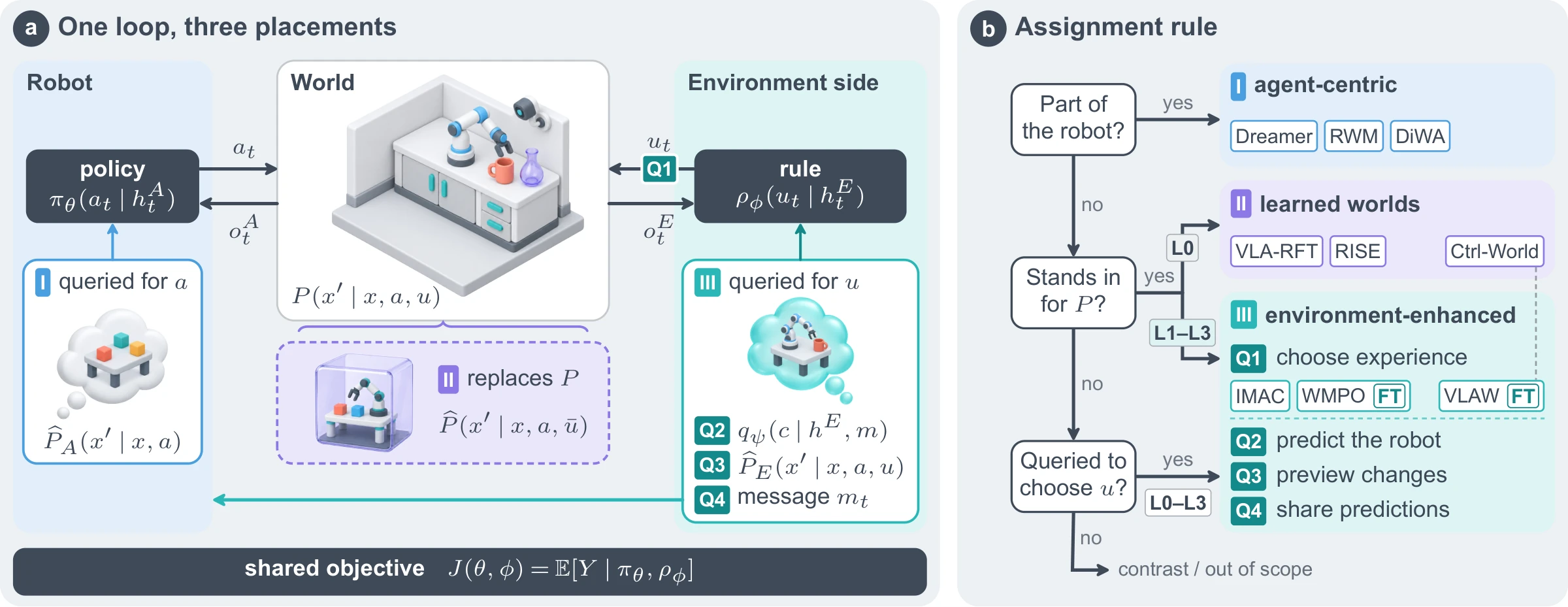
The survey describes embodied systems as one loop with two decision-makers: the robot’s policy chooses actions , and the environment side’s rule chooses interventions , such as what the robot experiences, how its world is configured or what it is told. The same kind of predictor can sit inside the robot, in place of the world, or with an environment side that predicts this robot and adapts to it. Each placement owes its own guarantee.

Survey Fig. 3 in two panels. (a) The loop: the robot’s policy sends actions a_t to the world P and receives observations; the environment side’s rule sends interventions u_t, badged Q1, and observes the world. A world model can sit inside the robot (I, queried for a), replace P (II), or sit with the environment side (III, queried for u), where Q2 predicts the robot, Q3 previews changes and Q4 sends a message m_t to the robot; a bar beneath shows the shared objective J of theta and phi. (b) The assignment rule as a first-match decision tree of three questions asked in order. Part of the robot? Yes gives Paradigm I, agent-centric (Dreamer, RWM, DiWA). Otherwise, stands in for P? Yes gives Paradigm II, learned worlds, at L0 (VLA-RFT, RISE, Ctrl-World), or Paradigm III, Q1 choose experience, at L1 to L3 (IMAC, WMPO and VLAW, the last two with fidelity tracking). Otherwise, queried to choose u? Yes gives Paradigm III at L0 to L3: Q2 predict the robot, Q3 preview changes, Q4 share predictions. A use that fails all three is a contrast or out of scope.

One loop, three placements (a), and the assignment rule that classifies each use of a world model by three questions asked in order (b).

Fig. 3 of the survey. Uses, not models, are classified; the order is conceptual, not a ranking. Full-size image

Paradigm I: Agent-centric world models

Inside the robot

: the joint physical and task state; : the robot’s action. The robot’s own learning algorithm maintains the model.

Queries
Learning in imagination; planning, verifying and scoring; acting through the model.
Must guarantee
Respond faithfully to the robot’s actions, accurate where errors would change its decisions.
Example
V-JEPA 2-AC plans pick-and-place zero-shot on real Franka arms from image goals, a preprint reports.

Paradigm II: Learned worlds

In place of the world

The conditions are fixed or chosen by humans; the model does not condition on this robot.

Uses
Training inside the model; data engines; policy evaluation; scenario generation; twins and physics hybrids; rewards and judges.
Must guarantee
Reproduce the outcomes that training or evaluation relies on, such as how real policies rank.
Example
A Veo-based simulator evaluates Gemini Robotics policies; its preprint checks the predicted rankings against more than 1,600 real trials.

Paradigm III: Environment-enhanced world models

With the environment side, serving the robot

: robot variables such as competence; : embodiment; : the environment side’s history (its evidence about the robot).

Prediction questions
Choose experience (Q1); predict the robot (Q2); preview changes (Q3); share predictions (Q4).
Must guarantee
Predict conditioned on this robot and on interventions chosen for it.
Example
Sirius-Fleet’s monitor requests human help on real robots where a visual world model predicts failure under the fleet’s shared policy.

Both rules are judged by one competence objective, , with the task outcome measured outside the adapting system: robot learning moves , and environment adaptation moves .

Classify a use with the assignment rule

Answer the three questions in order; the first match decides. You can also load a system from the taxonomy to see how the survey classifies it.

Is the model part of the robot?

It is an inner component of the robot’s own learning or control algorithm, for example a model the learner updates every iteration or whose uncertainty it penalizes; a model used only through its outputs and refit, if at all, in discrete rounds is not.

Does it stand in for the world ?

Its output serves as the robot’s experience or as the outcome by which the robot is judged.

Is it queried to choose an intervention for this robot?

The environment side uses its predictions to decide what to do for this robot.

Taxonomy of representative works

The 69 leaves of the survey’s taxonomy (Fig. 5 of the survey), grouped by placement and by query, use or prediction question; representative works, not a census. Select a work to see where it sits and how to cite it.

† preprint  ·  ★ strict core  ·  FT fidelity tracking  ·  L2 adaptation ladder level (Paradigm III)  ·  ↔ the same work, model or model family appears in two places

Evidence on environment-enhanced world models

An environment-enhanced world model is a predictive model held by the environment side, a rule other than the robot’s own policy update; in the strict core, this model is a learned world model. It is queried to choose an intervention meant to improve this robot’s learning, safety or task success: what the robot experiences, how its world is configured or what it is told. The term denotes neither data or environment augmentation nor a world model enhanced with environment information.

The survey groups these uses by four prediction questions: Q1 choose experience (what should this robot experience next?), Q2 predict the robot (how will it perform, and where will it fail?), Q3 preview changes (what follows if the environment changes?) and Q4 share predictions (what should the environment tell this robot?).

Evidence map

The evidence map (Fig. 9 of the survey) places 67 coded papers by prediction question and by the type of model the environment side queries. They are the papers that answer one of the four questions among 122 papers on environment adaptation, each coded twice independently and adjudicated (searches of October 12 and 13, 2026): a coded set, not a census. Of the 67, 59 are Paradigm III entries; the other 8, Q1 entries at L0, do not condition on the robot and are reviewed as learned worlds. Only the first column passes the strict world model test.

The survey’s first finding concerns placement: learned world models are rare where the environment side predicts the robot (Q2) or previews changes (Q3). There they account for 2 of 21 and 3 of 18 entries, against 16 surrogates or critics and 11 engines, twins or analytic models. An updated search in which learned world models reach parity with surrogates in Q2, or with engines and twins in Q3, would refute this finding.

Select a cell to list its entries.

Show
Coded entries by prediction question (rows) and by the type of model the environment side queries (columns)

On narrow screens the columns are abbreviated: WM world model, Critic surrogate or critic, Beh. behavior model, Eng. engine or twin.

Adaptation ladder

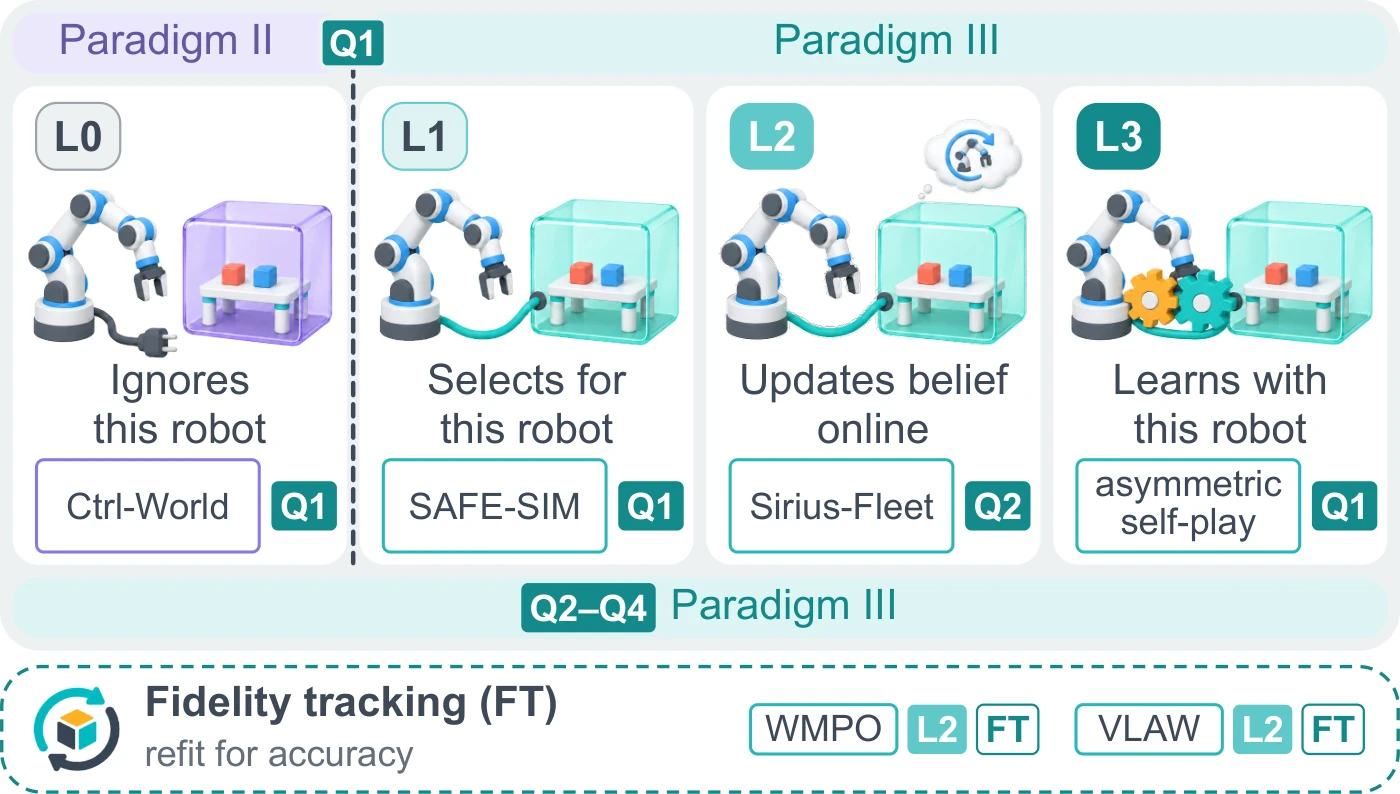
Survey Fig. 4: four panels of equal width for ladder levels L0 to L3, each with a robot arm and a glass cube. L0 ignores this robot (example Ctrl-World, Q1); L1 selects for this robot (SAFE-SIM, Q1); L2 updates belief online (Sirius-Fleet, Q2); L3 learns with this robot (asymmetric self-play, Q1). A dashed line after L0 marks the border between Paradigm II and Paradigm III for Q1; a band below notes that Q2 to Q4 are Paradigm III at every level. A side rail marks fidelity tracking, a refit for accuracy, with WMPO and VLAW at L2.

The adaptation ladder grades what the environment side conditions on and learns; fidelity tracking is a flag, not a rung.

Fig. 4 of the survey. Full-size image

On Q1, the line between L0 and L1 separates Paradigms II and III; Q2–Q4 are Paradigm III at every level. A higher level is not intrinsically better: fixed, verified infrastructure may suit settings where continual change would harm reliability.

Ladder level of the coded entries, by question

Follows the filters of the evidence map above.

Learned policy evaluators

Eleven representative learned policy evaluators (Fig. 8 of the survey), not a census, placed by the number of policies or checkpoints validated and the reported Pearson r with ground-truth success (for RoboWorld, RoboArena leaderboard scores). Values are taken unimputed from the primary papers; protocols differ, so markers are not a ranking. Validation is mostly rank or correlation agreement over a few fixed policies.

  • Filled: real-robot ground truth
  • Open: simulator ground truth
  • Circle area: real trials
  • Diamond: no real-trial total reported
  • Dashed ring: partly calibrated absolute success

The chart scrolls sideways on narrow screens.

Show the values as a table

Evaluation protocol

If an environment helps, a rising success rate cannot show that the robot learned. Where the environment side can be frozen or swapped while the robot is held fixed, the survey proposes to cross robot learning, which moves , with environment adaptation, which moves , and to read the interaction. The protocol is a proposed reporting standard, not a validated experiment.

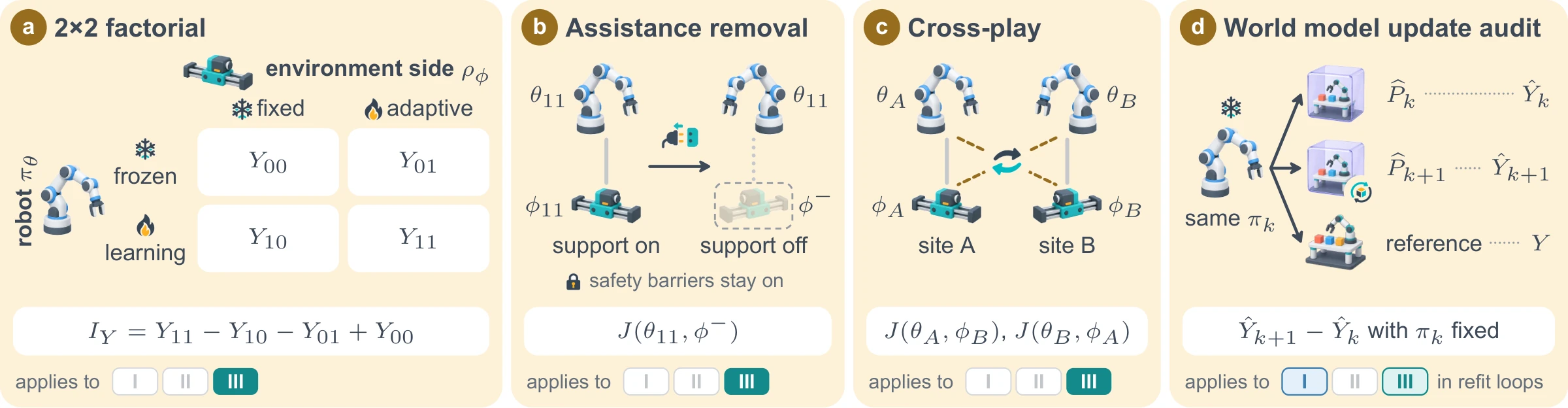
Survey Fig. 11 in four panels. (a) A two-by-two factorial: robot frozen or learning against environment side fixed or adaptive, cells Y00, Y01, Y10 and Y11, with I_Y equal to Y11 minus Y10 minus Y01 plus Y00. (b) Assistance removal: the same robot theta-11 with support on and with support off, safety barriers stay on, scored as J of theta-11 and phi-minus. (c) Cross-play: robots and environment sides from sites A and B exchanged. (d) World model update audit: the same policy pi-k scored in model versions P-hat-k and P-hat-k-plus-1 and against a reference.

Four checks that separate robot learning from environmental assistance: a 2×2 factorial (a), assistance removal (b), cross-play (c) and a world model update audit (d).

Fig. 11 of the survey. Chips under each panel mark the paradigms a check applies to; (d) applies to I and III only in refit loops. Full-size image

2×2 factorial
Switch robot learning off or on and hold the environment side fixed or let it adapt, from matched checkpoints. Arm yields , and the interaction is . The cells are experimental conditions, not reported results. is non-additivity on the chosen scale, not a mechanism. Report intervals over runs under equal-total and component-matched budgets.
Assistance removal
Score : withdraw reversible support to separate retained competence from supplied support. Never disable a safety barrier.
Cross-play
Exchange robots and environment sides adapted to other robots, seeds or facilities, and score and .
World model update audit
Score the same policy in and against a real or independent reference, so that a refit on the robot’s rollouts is not mistaken for robot progress.

Library of cited works

All 304 works the survey cites, checked against their primary pages. Filter by where the survey discusses them, by type or by year, and copy a BibTeX entry.

    Citation

    If you find the survey useful, please cite it as follows.

    BibTeX
    @misc{li2026worldmodels,
      title  = {{World Models Across the Embodied Loop: A Survey from
                Agent-Centric Prediction to Environment-Enhanced Adaptation}},
      author = {Li, Zirui and Ma, Boyu and Liu, Haochen and Jin, Zhehao and
                Wang, Zhidong and Yang, Lei and Zhao, Xiaocong and
                Shan, Zitong and Liang, Jingsong and Chen, Guang and
                Li, Shengbo Eben and Sun, Jian and Yang, Chenguang and
                Yang, Jianfei and Liu, Ziwei and Lv, Chen},
      year   = {2026},
      url    = {https://lzrbit.github.io/wm-eai/},
      note   = {Preprint}
    }